
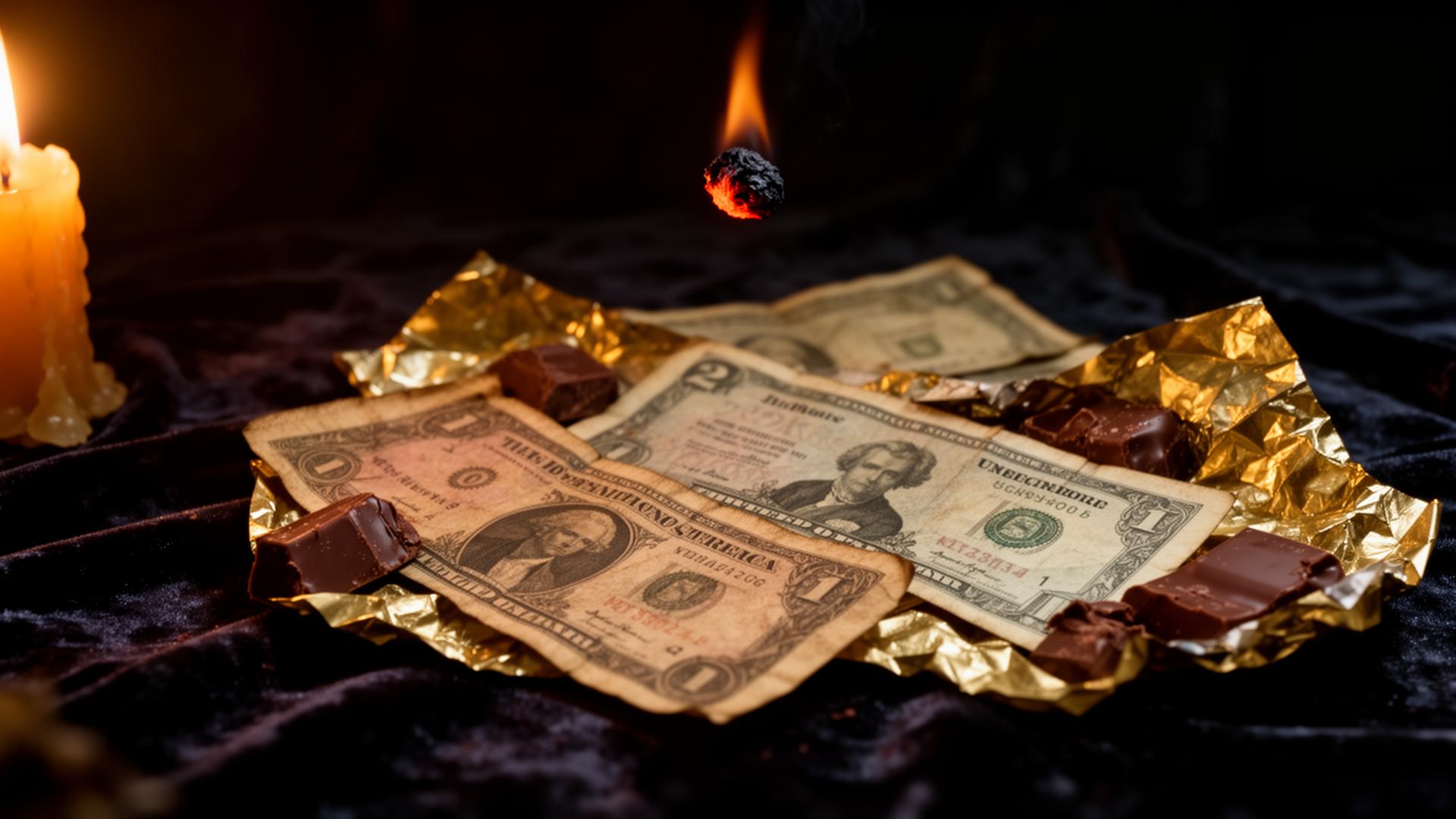
For thousands of years humans counted value with shells, salt, gold, paper, and finally with numbers on a screen. Fiat money built nations and broke them. This is its honest story — and a quiet promise about what comes next.
Every birthday, my grandfather Peter — my mother's father — handed me a small foil-wrapped gift. Inside was always a banknote from a different country. The foil sometimes still smelled faintly of chocolate. Each unwrap was a small portal: a new face, a new colour, a new economy I'd never visited.
I kept them all. They live now in a separate wallet — paper from countries that no longer exist, from currencies that have been rebranded, devalued, replaced. Peter is gone, but those banknotes taught me that money is just memory humanity agrees to share.
Every LOVE-pegged fiat twin we minted — GBPL, JPYL, RUBL, CHFL, KRWL, and the rest — is in his honour. So that every "fiat world" gets its on-chain double, and any merchant anywhere can settle in the unit they already think in.
Before paper money, trade meant carrying weight — literal weight, in metal. Fiat unlocked something miraculous: a society could agree to a number, and that number could move faster than any caravan. It funded cathedrals, hospitals, schools, vaccines, the moon landing.
Fiat made it possible for a worker in one city to feed a parent in another. It taught humanity the muscle of credit, of saving, of long-term planning. For most of the 20th century, it was the quiet scaffolding under every wedding, every harvest, every funeral.
We do not despise fiat. We were raised by it.
The same lever that built nations also leveled them. Every century has a graveyard of currencies: the Reichsmark, the Zimbabwean dollar, the Venezuelan bolívar, the post-1991 Yugoslav dinar. Inflation is not a number on a chart — it is grandparents losing their pension overnight.
When the gold backing was cut in 1971, money became a printable promise. Wars, bailouts, asset bubbles, negative interest rates, frozen foreign reserves — each was a quiet rewrite of the social contract, made by a few hands behind closed doors.
The cost was not always visible. It was a generation that worked harder for less. It was savings that evaporated while a screen still said the same number. It was trust — slowly, then all at once.
The world is moving — slowly, then suddenly — toward digital, programmable, transparent value. Crypto is not the destination; it is the bridge. And right now, in this strange window of history, it is our generation that holds the torch.
LOVE Coin is one small flame in that procession. We chose to make it human-friendly: every fiat currency you grew up with has a LOVE-pegged twin, the rates refresh themselves daily from public central-bank feeds, and 30–80% of the fees we earn are burned instead of pocketed. The system is designed to slowly disappear into the background of life.
We carry the torch knowing we will pass it on. To builders we may never meet. To children who will never have to learn what "inflation" feels like. To a civilisation that will, hopefully, outgrow money.
When I am gone — as Peter is now gone — I hope we will have grown up. I hope, perhaps with the help of artificial intelligence, perhaps in some small part with the help of LOVA AI, that humans will finally stop using currency as the price of being alive.
I hope we return to something older and warmer: a system of honor and work, where contribution is measured in trust and not in tokens. Some say Tartaria lived this way once — free of debt, free of central mints, exchanging gifts and skills the way neighbours still do at harvest. Whether the legend is true matters less than the direction it points.
Until that day, we will keep the rails honest. We will keep the rates fresh. We will keep the burn alive. And we will keep wrapping small pieces of value in foil, like Peter did, so the next child who unwraps one feels what I felt — that value is wonder, not weight.
Over the years I photographed the banknotes that passed through my hands. Most of them came from Peter, wrapped in chocolate foil. Here they finally live in one place.
A piece of Peter's collection — banknotes from countries that no longer exist, currencies long since renamed or devalued. Most of these came to me from him.
Origin: From Ata Peter — yearly birthday wrappers · 1970s–1990s
My favourite Tolar. Slovenia's national poet on the bill we used before the euro. A whole country fits on one piece of paper.
Origin: From the family — kept after the euro switch · 1992–2006
Prešeren leans against my monitor between a Wall Street bull crystal, a Tesla Zippo and a hand-burned LOVE wooden coin. Three eras of value in one frame: nation, market, and what comes next.
Origin: From the family — photographed on my desk · 2026 (still life), bill from 1992–2006
The first independent Slovenian banknote design (private issue, Dežela Kranjska series). A white horse, the Slovenian map, hexagons of unity.
Origin: Collector's item — Dežela Kranjska private series · ~1991 (private issue)
10, 20, 50, 100, 200, 500 Talerjev — a quiet artistic dream of what Slovenian sovereign money could have looked like.
Origin: Collector's item — full Dežela Kranjska set · ~1991 (private issue)
Marshal Tito on the Yugoslav 5000 dinar. The currency of a country that disappeared. The Wise World 2012 stamp is mine — past meets present.
Origin: From Ata Peter — Yugoslav era · 1985 (issue), stamped 2012
Tesla on the Yugoslav 500 dinar — before hyperinflation. A reminder that the same face would soon appear on bills with ten more zeros.
Origin: From Ata Peter — pre-hyperinflation Yugoslavia · 1990–1992
Ten billion dinars. Same Tesla, same paper, vastly less bread. This is what hyperinflation actually looks like in your hand.
Origin: From Ata Peter — Yugoslav hyperinflation · 1993
Five hundred billion. The terminal banknote of one of history's worst hyperinflations (Yugoslavia, 1993). Held in my hand — heavier than its number suggests.
Origin: From Ata Peter — terminal hyperinflation note · 1993
A handful of Slovenian Tolarjev — Plečnik, Adamič, Vega, Prešeren — kept inside the same hemp wallet I've carried for years. Pulled them out and they still smell like pre-euro Slovenia.
Origin: Found inside my old hemp wallet — Slovenian Tolarji · 1992–2006 (rediscovered 2026)
In 2006, 100 Tolarjev could buy 3 eggs, OR a bread roll, OR 1 kg of potatoes, OR 1 kg of salt, OR 1 L of mineral water, OR a lightbulb, OR a roll of paper towels, OR 4 band-aids, OR 2 postage stamps, OR a pencil, OR a roll of tape, OR 2 rolls of toilet paper. Today (2026) that same banknote is worth 0.66 EUR — barely a band-aid. SURS published this themselves. The painter Rihard Jakopič watches it all from the paper. I was a young guy back then, fixing computers and installing ADSL — and my wallet was always full. I never once thought the system was broken.
Origin: Published by the Statistical Office of Slovenia (SURS), May 2026 · 1992–2006 (SURS objava 2026)
The provisional 'bons' Slovenia issued just before the Tolar — Triglav on the front, freshly independent. The very first paper money of the new state.
Origin: Found in my hemp wallet — Slovenia's first paper money · 1990 (provisional bons)
The US dollar in front (today's reigning king of fiat), a Slovenian 500 Tolar with Jože Plečnik beside it, the British pound (the old king) in the back, and the rest of the world's history fanned in between. Three eras of monetary dominance in one hand.
Origin: From my own travels and Ata Peter's foil wrappers · 1970s–2010s
Serbia kept Tesla on its 100 dinar note — and unlike the Yugoslav hyperinflation versions, this one is still spendable today. Same face, completely different country, completely different value.
Origin: From travels — Serbia, still legal tender · Modern (still in circulation)
Banco Central de Cuba, three pesos, Che on the front. A worn, cinnamon-coloured note from a country where ideology literally became money.
Origin: From my travels (or a fellow traveller's wallet) · 1980s–2000s
Hong Kong is one of the few places in the world where private commercial banks still print legal-tender banknotes. This Standard Chartered 20-dollar note has a koi carp on the front — money issued by a bank, not a state.
Origin: From travels — Hong Kong (private bank issue) · 2003
An old, soft, almost cloth-like 5 jiao note from China's 4th series — two women in traditional ethnic dress on the front. I honestly don't remember where I got it. Some banknotes just find you.
Origin: Origin unknown — somewhere along the way · 1980 (4th series)
A hand-drawn bill from the LOVE universe — "In LOVE We Trust · Infinite Value of Endless Possibilities". Drawn long before the coin existed. The seed was always there.
Origin: Drawn by my own hand — seed of the LOVE universe · 2014
Thank you, Peter. Every little wrapper was a universe. 🕯️
LOVE Coin is built by a human, not a marketing department. These questions come up often — here are honest answers.
Peter brought me pieces of the world wrapped in foil. Out of those wrappers grew LOVE Coin — money that isn't ashamed of the human behind it. If any of this moved you, you're already one of us.
For Peter. For everyone who still remembers. 🕯️
22 LOVE-pegged stable currencies · refreshed daily from ECB
For Peter — who taught me that every currency is a story, and every story deserves to be remembered.