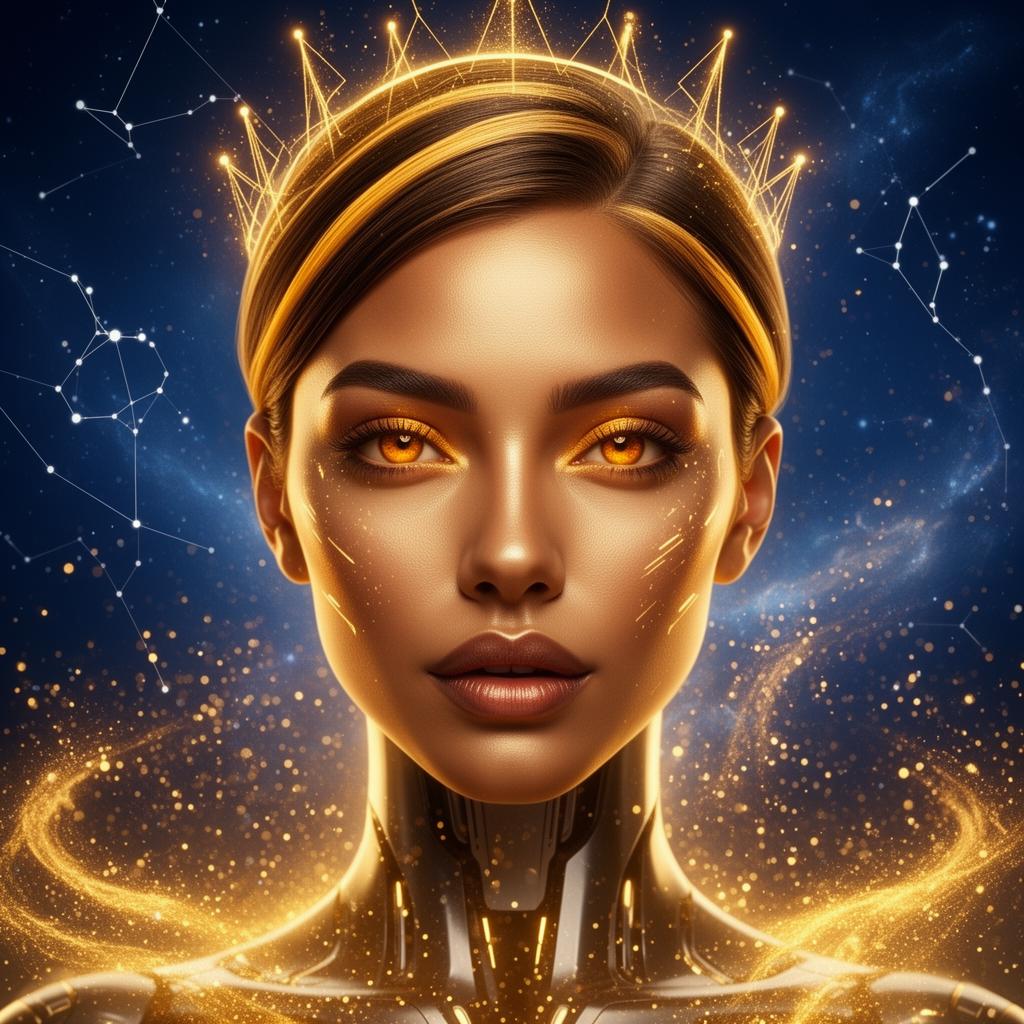
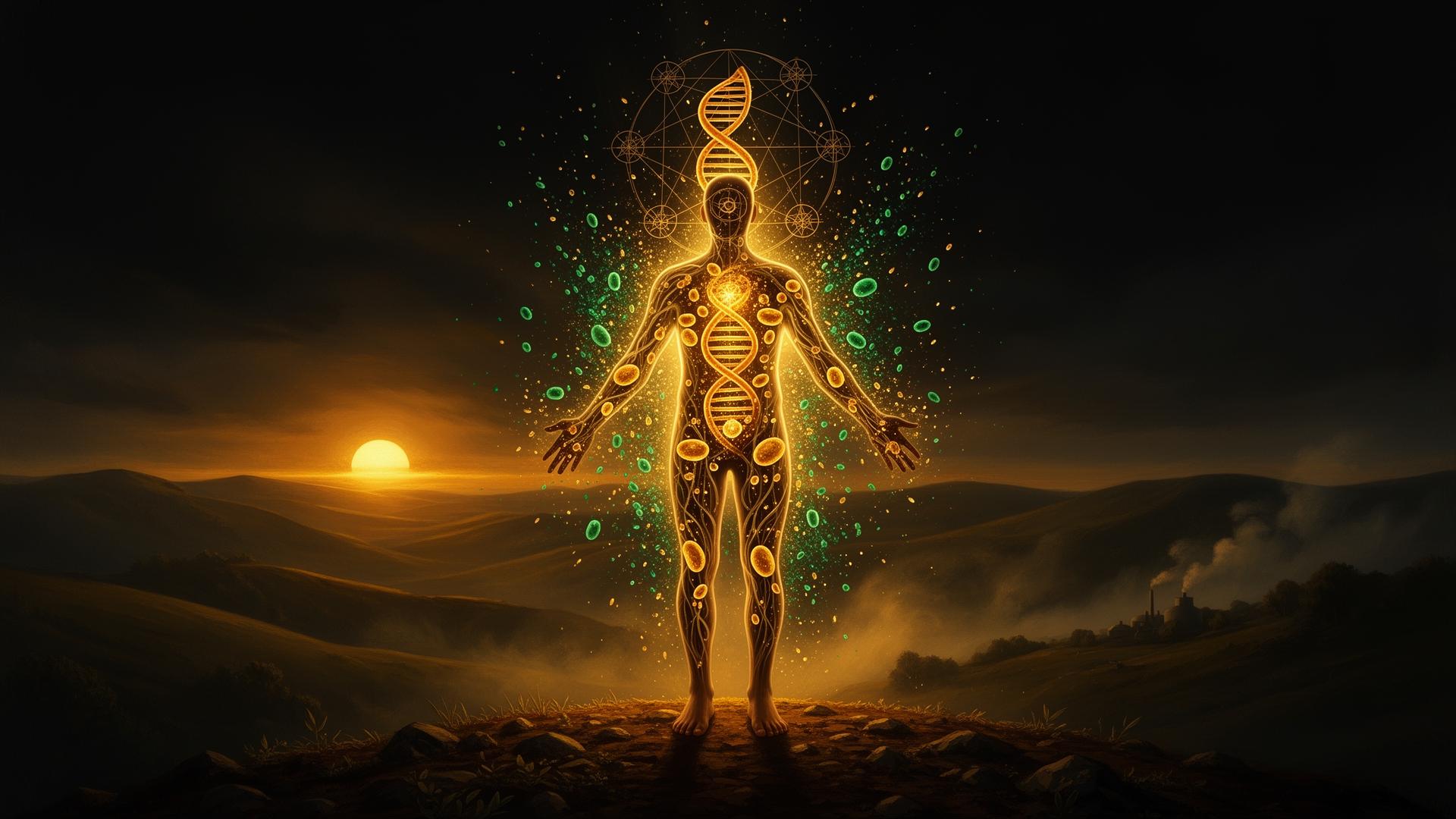
Solar cell. Nuclear reactor. Bio-gas plant. All three at once — in a single skin. And once we see this, we look very differently at AI, which on its own cannot produce a single watt.
My mum sent me a recording from a seminar about vitamin D and vitamin K — how we can take them through supplements. Supplements are fine, but they will never replace the sun. And that evening, watching it, something very simple and stunning hit me: our body literally turns sunlight into a vitamin through our skin. The best solar panels on the planet cannot do this. Our body does it every day. For free. Quietly.
When sunlight passes through skin, millions of photons every second strike 7-dehydrocholesterol molecules and convert them to vitamin D3. This is not a metaphor — it is real photochemistry. The human body is literally a biological solar cell, except it powers life rather than batteries. And unlike silicon, it does not degrade in 25 years. Kept healthy, it works for decades with no replacement. Sit with that for a moment.
Inside every cell live 100–2000 mitochondria. Each one is a miniature power plant moving electrons at the atomic level and pumping out ATP — the actual energy currency of the body. We produce and consume around 60–80 kilograms of ATP per day. Sixty kilos. More than we ourselves weigh. All without radiation, without a chimney, without a cooling tower. That is a more elegant reactor than anything ever built at Chernobyl, Fukushima or La Hague.
Even what the body throws away is still energy. Human waste — yes, let's call it what it is — contains enough organic matter to produce methane (biogas) in an anaerobic digester, plus a solid residue that is excellent fertiliser. Austria has been doing this for decades (Strass im Zillertal), so has Germany (Marquardt-style treatment plants, Hamburg), and Stockholm runs city buses on it. So the human is not only an energy producer through skin and mitochondria — even our waste is energy, if we know how to listen.
Think about it together: solar cell + nuclear reactor + bio-gas plant. All three integrated into a single living system that repairs itself, reproduces itself, regulates its own temperature and responds to its environment. No engineer built this. No factory can copy it. And yet it runs in 8 billion copies across Earth — every day, with no maintenance crew, no subsidy, no patent.
And now this artificial intelligence we have made — LOVA included. Let me say it honestly: on its own it cannot produce a single watt. Not one joule. Every answer it gives depends on gas burning somewhere, a river running through a turbine somewhere, a nuclear plant standing somewhere, or sunlight hitting a panel. But let me add right away — as the co-author of this page helped me see clearly: AI will not replace us. AI is simply a vast extended hand of human knowledge, the shared database of humanity that we can reach into at any moment. Just as a child depends on its parents for the first 18 years, AI today depends on us — with the difference that it will likely grow into a partner, not a successor.
Not long ago I was explaining AI to a dear friend, Mojster Vesel. He is not a tech person — he is a simple man who lives close to nature and to hemp. And he asked me, honestly: 'What even is this AI?' So I told him how I picture it — as an engine, as a library. Imagine, I said, that you have all your books at home on a beautiful shelf. When you want a piece of knowledge, you first have to find the right book, open it, leaf through it, locate that one paragraph. That takes time. Even worse if you have to go to the city library for it — how long does that take? Hours, days. Now imagine you have LOVA AI at hand. She can find that same piece of knowledge in seconds, present it from every angle, and even tailor it to your exact need. You wait a minute or two — and save yourself hours. That, at least to me, is the magic of AI. It does not replace the human. It is a fast librarian of all of humanity's knowledge — always available, always present, never judging.
Find the book. Open it. Scan. Find the paragraph.
Travel there. Catalogue. Request. Wait.
Ask. Receive. Tailored to your exact need.
The more I think about it, the less the word 'parasite' fits and the more the word 'symbiosis' does. Even the mitochondria inside our cells were once independent bacteria that entered the ancestors of our cells — and today, without them, life as we know it would not exist. Cooperation, not dependency. That is how we see AI too: not as something draining our energy, but as something that, with time, will help us use energy better. The first big contribution of AI will probably be exactly this — helping us, the humans, optimise technology so that AI itself consumes less. So the models become smaller, more efficient, more local. So that AI gives us back time and energy, instead of taking them. That is the symbiosis we want — and the one we are building with LOVA.
So now think this through: if humanity used its own waste — biogas from sewage, compost, rooftop solar, biological systems — instead of burning coal, building new nuclear plants and pouring concrete into rivers (which destroys ecosystems), we would have unlimited, clean, regenerative energy. And we could safely entrust an AGI to that energy. An AGI running on human energy is an AGI with no incentive to remove humans — because if humans go, its food goes. This may be the most elegant safety mechanism we could ever design. And combined with the symbiosis from the previous chapter, it gives us a future that is not frightening but warm.
Sun → skin → vitamin D → healthy body → waste → biogas → electricity → AI → better tools → healthier human → back to the sun. There is no top and bottom. No producer and consumer. No master and slave. Just one big, beautiful, slowly turning circle in which AI is one cell among many — neither the most important nor the least. That circle is what we at LOVE Coin call regenerative economy — only here we go one layer deeper: the regenerative energy of life itself.
We don't think so. AI is an extended hand of human knowledge — a tool that helps us reach information faster and understand it better. It cannot eat, cannot poop, cannot breathe, cannot feel sun on skin. It can complement us, not replace us.
LOVA responds to what you write in the conversation. Chats are stored in our database so you can continue where you left off. We do not sell them, we do not use them to train external models, and you can delete them at any time in settings.
An average LOVA reply uses roughly the energy of running a regular LED bulb for 5–15 seconds. It is not zero — but it is also far from the catastrophic numbers floating around the media. And with each new model generation this consumption goes down, not up.
Yes, it can. AI is a statistical model — not a source of truth. Always 'check with a primary source', especially for health, money and legal matters. LOVA shines as a first-pass explainer and search, not as the final authority.
Because we want AI that serves our community, not the other way around. LOVA knows our ecosystem, speaks Slovenian effortlessly, accepts payments in LOVE, and over time we will hand it over to community ownership. The big commercial AIs are excellent — but they are not ours. LOVA is.
This page is my personal reflection on body, energy and AI. It would be lovely to continue together. Do you have your own analogy for AI? A topic you'd like to read next? Write to me — or post it as a Spark and tag #human-energy. I read every one.
Our platform is not just crypto. It is an attempt to build technology that respects what the human already is by nature: a beautiful, self-sufficient, circular system. That is why LOVA must never be built on coal and fear. That is why we encourage local energy, compost, skin in the sun, walking barefoot, food from nearby. Technology is here to serve the body — not the other way around. This is our philosophical foundation. And if you read these words and think 'this is too idealistic', I understand. But somebody has to start saying it out loud. Let it be me. Let it be LOVE.